

EU Battery Passport 2027: Which Batteries Need One and Who Is Responsible?
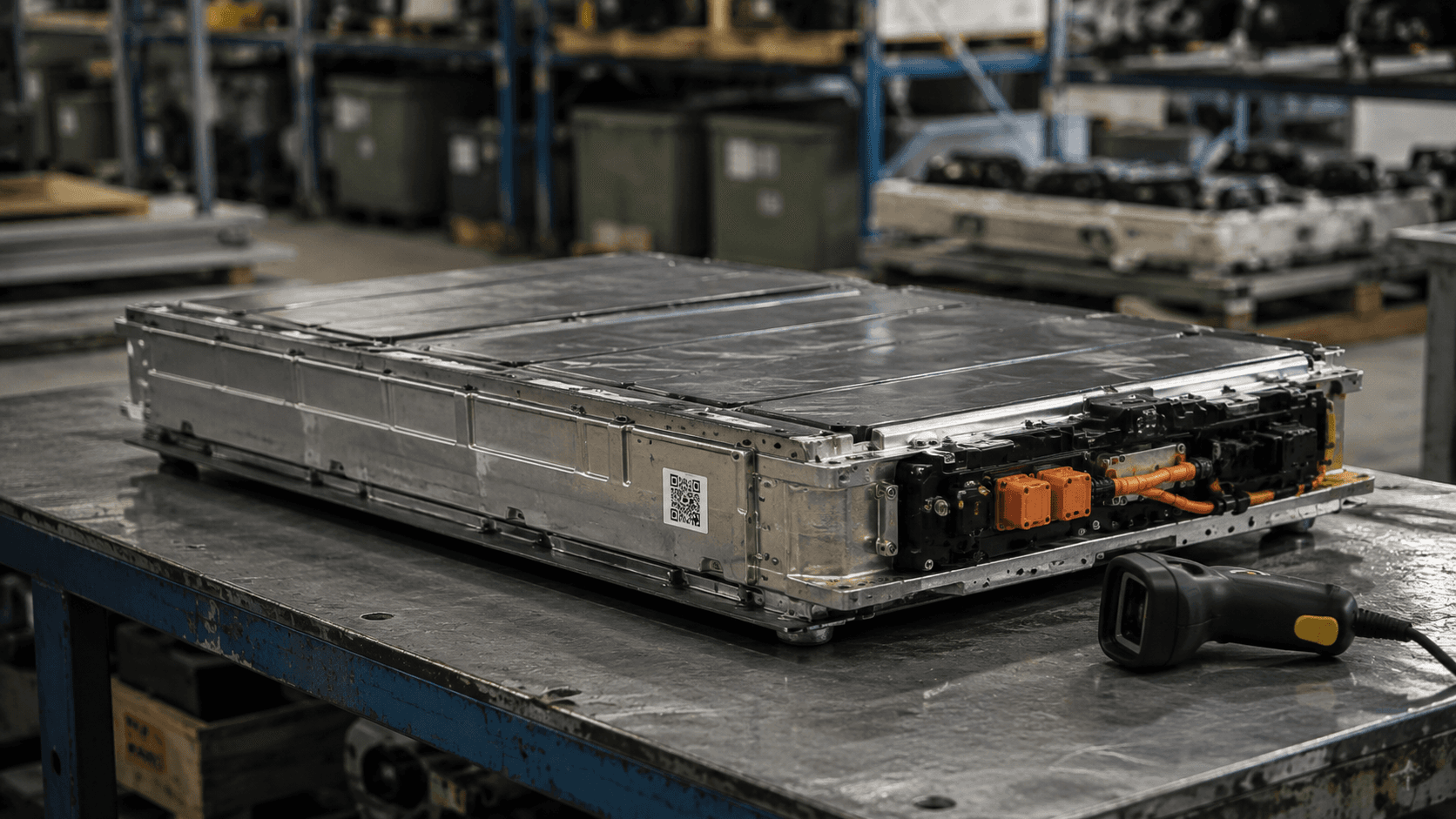
From 18 February 2027, certain batteries placed on the EU market must have a digital battery passport.
The obligation does not apply to every battery.
It covers electric vehicle batteries, batteries for light means of transport and industrial batteries with a capacity greater than 2 kWh. Ordinary portable batteries, most batteries used in small electrical devices and standard automotive starter batteries are not subject to the battery passport requirement solely because they are sold in the EU.
For companies within scope, the passport is more than a digital product label. It must combine information about the battery model with data relating to the individual battery and remain available throughout much of the battery’s lifecycle.
The first step is therefore to determine which batteries are covered and which company is responsible for creating and maintaining the passport.
What changes on 18 February 2027?
The battery passport is introduced by Regulation (EU) 2023/1542 on batteries and waste batteries.
From 18 February 2027, every covered battery placed on the EU market or put into service must have an electronic record linked to that individual battery.
The passport must be accessible through a QR code connected to a unique identifier. It will contain information intended for different users, including consumers, authorities, repairers, remanufacturers, second-life operators and recyclers.
The obligation applies to batteries placed on the market or put into service from the application date. It is not a general requirement to create passports retrospectively for every battery previously sold in the EU.
Companies should nevertheless document when individual batteries were first placed on the market. Goods held in a warehouse before February 2027 may still require a passport if they have not yet been legally placed on the EU market.
Which batteries need a battery passport?
The requirement applies to three categories.
Electric vehicle batteries
Electric vehicle batteries used to provide traction power in hybrid or electric vehicles require a battery passport.
The obligation applies to the battery itself, even where it is incorporated into a complete vehicle when supplied to the customer.
Batteries for light means of transport
All batteries classified as light means of transport batteries require a passport. These are sealed batteries weighing no more than 25 kg that provide traction power to wheeled vehicles powered by an electric motor.
Typical examples include batteries for:
- electric bicycles;
- electric scooters;
- electric mopeds;
- similar light electric vehicles.
Unlike industrial batteries, the passport requirement for this category is not subject to a 2 kWh capacity threshold.
Industrial batteries above 2 kWh
Industrial batteries with a capacity greater than 2 kWh also require a passport.
This category can include batteries designed for industrial use as well as batteries that do not fall within another specific category under the Regulation. Depending on their design and intended use, examples may include:
- home and commercial energy-storage batteries;
- batteries for industrial machinery;
- uninterruptible power-supply systems;
- batteries used in telecommunications infrastructure;
- large batteries used in data centres or renewable-energy installations.
The threshold is strictly greater than 2 kWh. An industrial battery with a capacity of exactly 2 kWh is not covered by Article 77 on that basis.
Correct battery classification remains essential. A battery should not be treated as industrial merely because it is sold to a business, and a B2B sales model does not determine whether a passport is required.
Which batteries are not covered?
The battery passport requirement does not currently apply to every battery category.
The following batteries are generally outside the passport scope unless they independently meet the definition of a covered battery:
- ordinary portable batteries;
- button cells;
- batteries used in most small consumer electronics;
- starting, lighting and ignition batteries;
- industrial batteries with a capacity of 2 kWh or less.
A laptop, power tool or household appliance containing a small portable battery does not normally require a battery passport.
This does not mean that the battery is exempt from the EU Batteries Regulation. Other requirements concerning conformity, labelling, removability, substances, performance, producer registration, take-back and waste management may still apply.
The battery passport is one obligation within the wider regulatory framework, not the test for whether a battery is regulated.
What about batteries incorporated into other products?
A battery does not fall outside the requirement merely because it is incorporated into a vehicle, machine or energy-storage product.
The relevant question is whether the incorporated battery belongs to one of the covered categories.
An electric bicycle battery remains an LMT battery. An electric vehicle battery remains an electric vehicle battery. A large battery integrated into an industrial system may remain an industrial battery above 2 kWh.
By contrast, the inclusion of a small portable battery in an electrical appliance does not create a passport obligation for the entire appliance.
Companies selling products with incorporated batteries should assess the battery separately from the equipment. They should also determine whether the battery is supplied as a finished battery or whether individual cells and modules are incorporated into a finished battery system later in the supply chain.
Who is responsible for the battery passport?
The obligation lies with the economic operator that places the finished battery on the EU market or puts it into service.
This is not automatically the company that manufactures the cells or individual modules.
Depending on the supply chain, the responsible economic operator may be:
- an EU battery manufacturer;
- an importer bringing a finished battery into the EU;
- a vehicle or equipment manufacturer;
- a company placing a battery on the market under its own name or trademark;
- an operator placing a repurposed or remanufactured battery on the market.
The responsible company must ensure that the information in the passport is accurate, complete and up to date.
It may authorise another operator in writing to act on its behalf. A specialist service provider may therefore host the data, create the technical passport or manage updates, but outsourcing does not automatically transfer the legal responsibility.
Example 1: An EU manufacturer sells storage batteries
An EU company manufactures finished 5 kWh energy-storage batteries and supplies them to installers.
The batteries are industrial batteries with a capacity greater than 2 kWh. The manufacturer placing them on the EU market must ensure that each battery has its own passport from 18 February 2027.
The installer does not normally become responsible for creating a second passport merely because it installs the battery at the customer’s premises.
Example 2: An EU importer purchases batteries from Asia
An EU company imports finished e-bike batteries from a manufacturer outside the EU and distributes them under the foreign manufacturer’s brand.
The batteries are LMT batteries and therefore require passports regardless of whether their capacity exceeds 2 kWh.
Where the EU importer is the economic operator placing the finished batteries on the EU market, it must ensure that compliant passports exist. A contractual promise from the non-EU supplier does not remove the importer’s responsibility.
The importer will therefore need reliable access to manufacturing, composition, performance and sustainability data from the supplier.
Example 3: A vehicle manufacturer purchases battery modules
A vehicle manufacturer purchases cells or modules and assembles them into a finished electric vehicle battery.
The suppliers of the individual components are not responsible for the passport of the finished battery solely because their components are used in it.
The company placing the completed battery or vehicle containing that battery on the market must determine whether it is the responsible economic operator and ensure that the individual battery is properly identified.
Contracts with cell and module suppliers should still require the technical and supply-chain information needed to complete the passport.
Example 4: A company imports equipment containing a large battery
An EU company imports industrial equipment containing an integrated 10 kWh battery.
The fact that the battery is already installed does not remove it from the passport requirement. The importer must assess who places the finished battery on the EU market and whether a valid passport and registered identifier exist.
This assessment should be completed before importation rather than after the product has reached the customer.
What information must the passport contain?
The passport combines information relating to the battery model with information specific to the individual battery.
The exact information depends on the battery category and on whether the underlying requirement is already applicable. Not every data field will be relevant to every battery from the same date.
Publicly accessible information may include:
- identification of the battery and manufacturer;
- battery category and model;
- manufacturing place and date;
- weight, chemistry and material composition;
- hazardous substances and critical raw materials;
- rated capacity;
- carbon-footprint information;
- recycled and renewable content;
- information on responsible sourcing;
- expected lifetime and applicable commercial warranty;
- information for waste prevention and management.
The passport must also contain restricted information. Access depends on the user’s role and legitimate need.
This can include detailed composition data, sources of replacement parts, dismantling instructions, safety measures, compliance test reports, state-of-health information and data resulting from the battery’s use.
Individual battery data may include charging and discharging cycles, state of charge, operating temperatures, significant incidents and whether the battery is original, reused, repurposed, remanufactured or waste.
The passport is therefore not a static copy of the technical data sheet. Certain information may need to be updated during the battery’s use and after changes to its status.
Will all information be public?
No.
The Batteries Regulation establishes different access levels.
Consumers and the general public will have access to specified model and sustainability information. Market-surveillance authorities, notified bodies and the European Commission will have access to additional compliance information.
Repairers, remanufacturers, second-life operators, recyclers and other parties with a legitimate interest may receive access to information needed for activities such as dismantling, repair, repurposing and recycling.
Commercially sensitive information is not intended to be publicly available without restriction.
As of July 2026, further rules specifying who qualifies as a person with a legitimate interest and how restricted information may be downloaded, shared, published or reused are still expected under an implementing act required by 18 August 2026.
Companies should therefore build their systems around differentiated access rights rather than assume that one public webpage will be sufficient.
How will the QR code and EU Registry work?
Each battery passport must be accessible through a QR code linked to a unique identifier assigned to the battery.
The detailed passport information will not all be stored in one central EU database. The system follows a decentralised model under which the responsible economic operator, or a service provider acting on its behalf, maintains the underlying data.
The EU Digital Product Passport Registry acts as an index. It stores unique identifiers, registration information and specified metadata rather than the complete contents of every passport.
The European Commission launched the operational Registry and a separate testing environment on 20 July 2026. Economic operators can therefore begin enrolling their organisations, testing registration processes and reviewing the available technical guidance before the battery passport becomes mandatory.
Commission Implementing Regulation (EU) 2026/1778 sets out the operational arrangements for the Registry, including user verification, access management, data registration and system operation.
The responsible economic operator must upload the battery’s unique identifier to the Registry before the relevant product is placed on the EU market, in accordance with the applicable rules.
Customs and market-surveillance authorities will be able to use the Registry to support compliance checks.
Can one passport cover an entire battery model?
Not on its own.
Some information can be shared at model level, but the Regulation requires an electronic record for each covered battery.
The passport must therefore connect common model information with a unique identifier and individual data for the specific battery.
A manufacturer producing 10,000 identical batteries cannot rely solely on one general product webpage without an individual identification structure.
Companies will need a system that can manage both:
- stable data shared by all batteries of the same model;
- dynamic or individual data assigned to each battery.
This distinction has significant implications for serialisation, database architecture, supplier data and integration with battery-management systems.
What happens when a battery is repurposed or remanufactured?
A battery that has been prepared for reuse, repurposed or remanufactured may require a new battery passport.
The new passport must be linked to the passport or passports of the original battery or batteries. Responsibility transfers to the economic operator that places the changed battery on the market or puts it into service.
This is particularly relevant where several original batteries or modules are combined into a new storage system.
The passport should preserve traceability while recording the battery’s new status and relevant performance information.
When a battery becomes waste, responsibility for maintaining the relevant passport information transfers to the producer, the appointed producer responsibility organisation or the selected waste-management operator, depending on the applicable arrangement.
The passport ceases to exist after the battery has been recycled.
Does the battery passport replace the EU declaration of conformity?
No.
The battery passport is a digital information and traceability requirement. It does not replace the manufacturer’s broader product-compliance obligations.
Manufacturers must still assess conformity, prepare the required technical documentation and issue an EU declaration of conformity where required by the Batteries Regulation.
The passport may provide access to some related information, but it is not itself proof that every regulatory requirement has been met.
Companies should therefore treat the passport as one part of the product compliance file rather than as a substitute for it.
Does the battery passport replace EPR registration?
No.
The battery passport and Extended Producer Responsibility address different obligations.
The passport is attached to an individual battery and supports product information, traceability, repair, second-life use and recycling.
Battery EPR determines which company must register as a producer in a Member State and finance the collection and treatment of waste batteries. It can require:
- national producer registration;
- membership of a producer responsibility organisation;
- appointment of an authorised representative;
- periodic volume reporting;
- financing of collection and recycling;
- take-back and consumer-information measures.
A company may therefore need one EU-compatible passport for each covered battery while also maintaining separate EPR registrations in several Member States.
The economic operator responsible for the passport is not necessarily the same legal entity that qualifies as the EPR producer in every country. Both assessments must be completed separately.
What should companies prepare now?
The 2027 deadline requires coordination between compliance, product development, IT, procurement and supply-chain teams.
Companies should first map every battery placed on the EU market and record its category, capacity, manufacturer, importer, sales route and incorporation into other products.
For potentially covered batteries, the preparation should then address:
- Which legal entity places the finished battery on the market or puts it into service?
- Which model-level and individual data are already available?
- Which missing information must be obtained from suppliers?
- How will each battery receive a compliant unique identifier and QR code?
- Where will the underlying passport data be hosted?
- Who may access, add or update each category of information?
- How will changes in state of health and battery status be recorded?
- How will the passport remain available if the responsible company or service provider ceases operating?
- How will identifiers be registered in the EU DPP Registry?
- Which national battery EPR registrations remain separately required?
Importers should pay particular attention to supplier contracts. A non-EU manufacturer may hold much of the required data, but the EU economic operator can still be responsible for ensuring that a complete and accurate passport is available.
The passport is an EU product requirement, not an EPR shortcut
The EU battery passport will create a common digital information structure for major batteries placed on the European market.
It will not create one central compliance process for all battery obligations.
Companies must still distinguish between product conformity, digital passport responsibility and national Extended Producer Responsibility. These roles can fall on different legal entities and require different data, systems and registrations.
Businesses that begin with a clear product and supply-chain assessment will be better placed to meet the February 2027 deadline without delaying imports or market access.
Viron Compliance supports battery manufacturers, importers and sellers with national EPR obligation assessments, producer registrations, authorised representation and ongoing battery reporting across Europe. We help companies coordinate these requirements alongside the wider obligations introduced by the EU Batteries Regulation.