
EU Fishing Gear EPR: Which Products and Companies Are Covered?
Fishing gear containing plastic is subject to a separate Extended Producer Responsibility framework in the European Union.
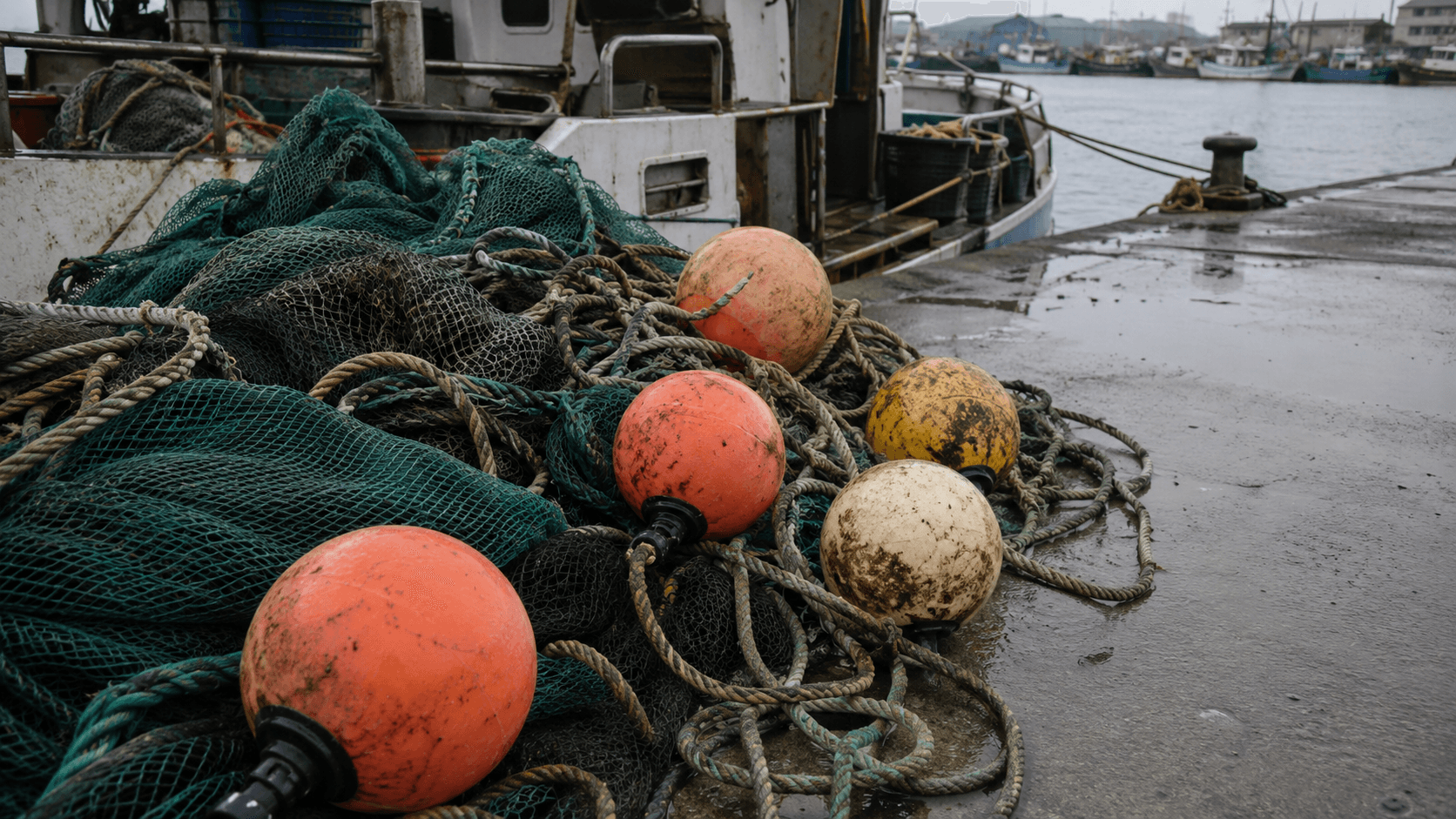
The obligation is not limited to large commercial fishing nets. Depending on the product and national implementation, it can also affect suppliers of ropes, lines, traps, floats, aquaculture equipment and products used for recreational fishing.
EU Member States were required to establish EPR systems for fishing gear containing plastic by 31 December 2024. Producers may now face national registration, reporting, authorised-representative and financing obligations in the countries where they place covered products on the market.
The first EU-wide reporting results, published in April 2026, show that approximately 22,900 tonnes of fishing gear containing plastic were placed on the EU market in 2022. Around one third was reported as collected waste. The data has increased regulatory visibility around a product stream that many manufacturers and distributors have not traditionally treated as EPR-relevant.
Why fishing gear has its own EPR framework
Lost, abandoned and discarded fishing gear can remain in the marine environment for long periods. Nets, lines and traps may continue to capture marine animals after they are no longer under the control of a fisher, a process commonly described as ghost fishing.
The Single-Use Plastics Directive therefore regulates fishing gear containing plastic alongside specified single-use plastic products.
This does not mean that fishing gear is legally classified as single-use. The Directive expressly applies to fishing gear containing plastic as a separate product category, including products designed to be used repeatedly over several years.
The framework follows the polluter-pays principle. Producers finance the management of fishing gear when it reaches the end of its useful life, while Member States organise national collection, reporting and enforcement arrangements.
What is fishing gear under the Directive?
Fishing gear is defined as any item or piece of equipment used in fishing or aquaculture to target, capture or rear marine biological resources.
The definition also covers equipment floating on the surface of the sea and deployed to attract, capture or rear those resources. It therefore expressly includes both fishing and aquaculture applications.
The legal assessment depends on the intended function of the product.
A general-purpose rope does not automatically become fishing gear simply because one customer uses it on a boat. The position can be different where the rope is designed, marketed or supplied as part of a fishing net, aquaculture installation or another system used to capture or rear marine organisms.
Similarly, products used around a harbour or vessel are not necessarily fishing gear. Equipment used for mooring, cargo handling, navigation or general vessel maintenance must be distinguished from equipment used for the fishing or aquaculture activity itself.
Product descriptions, technical specifications, marketing material and the intended application can all be relevant to the assessment.
How much plastic must the product contain?
The legislation applies to fishing gear that contains plastic.
The complete product does not have to be made predominantly from plastic. A product containing metal, rubber, natural fibres and plastic components can still fall within scope.
The definition of waste fishing gear also includes components, substances and materials that formed part of or were attached to the gear when it was discarded, abandoned or lost.
This is relevant to products such as:
- metal traps containing plastic netting or ropes;
- buoys with plastic bodies and metal fittings;
- weighted nets containing plastic fibres and metal components;
- aquaculture structures combining plastic, rubber and steel;
- lines and ropes made from synthetic polymers;
- fishing systems assembled from several separately supplied components.
A small plastic component can therefore be legally relevant. However, the precise treatment of accessories and replacement components may depend on their function and on how the national legislation defines reportable products.
Which product groups may be covered?
The EU reporting framework separates fishing gear into several broad categories. These include net panels made from thick twine, net panels and lines made from thin twine, other plastic-based gear or components, and buoys, floats and ropes.
The reporting format can further distinguish materials such as polypropylene, polyethylene, high-molecular-weight polyethylene, nylon and other polymers. It also provides for data concerning certain non-plastic parts of the complete fishing gear.
Potentially relevant products can therefore include:
- commercial fishing nets;
- net panels and replacement net sections;
- fishing lines and synthetic twines;
- ropes used as part of fishing or aquaculture gear;
- traps, pots and creels containing plastic components;
- buoys and floats deployed as part of fishing gear;
- components of fish-farming cages;
- aquaculture nets and containment systems;
- product-specific connectors and assembling elements;
- certain recreational fishing products.
The legal scope should not be determined from the product name alone. A buoy used for fishing gear and an otherwise identical buoy used only for navigation may have different regulatory treatment.
Does the obligation apply only to commercial fishing?
No general commercial-fishing limitation appears in the EU definition.
The 2026 FAMENET report commissioned within the EU fisheries framework expressly notes that the definition covers items used in fishing or aquaculture without distinguishing between commercial and recreational fishing gear.
This means that products supplied for angling, sport fishing or other recreational activities should not automatically be excluded.
The outcome still depends on the specific product. An item must meet the legal definition of fishing gear and contain plastic. General outdoor equipment, clothing and products used only for transporting or storing fish are not necessarily covered.
Member States may also use different registration categories and administrative interpretations when implementing the Directive. A recreational fishing product may consequently require a national scope assessment even where an apparently similar product is treated differently in another country.
Aquaculture equipment is expressly included
Aquaculture is not a secondary or optional part of the definition.
Equipment used to rear marine biological resources can qualify as fishing gear for the purposes of the Single-Use Plastics Directive. The EU reporting system therefore requires Member States to account for both fishing and aquaculture gear containing plastic.
Potentially affected aquaculture suppliers include businesses providing netting, ropes, floats, containment systems and components assembled into fish-farming infrastructure.
The fact that equipment remains installed at one facility for an extended period does not automatically exclude it. Fishing gear can be durable and used repeatedly while still falling within the EPR framework.
However, not every plastic component used at an aquaculture site is necessarily fishing gear. Pumps, monitoring equipment, ordinary packaging, maintenance products and general construction materials may instead fall under other regulatory frameworks.
Companies supplying complete aquaculture systems may therefore need to separate the covered fishing-gear components from unrelated equipment and packaging.
Who is the producer?
The producer is not necessarily the business that physically manufactures the plastic material or individual component.
Under the Single-Use Plastics Directive, the producer definition includes a company established in a Member State that professionally manufactures, sells or imports fishing gear containing plastic and places it on the market of that Member State.
The definition also covers companies established in another EU Member State or outside the EU that sell covered products directly to private households or other users in a Member State through distance contracts.
Depending on the supply chain, the producer can therefore be:
- a domestic manufacturer;
- an importer of fishing or aquaculture equipment;
- a brand owner selling products under its own name;
- a distributor first placing imported products on a national market;
- an online retailer selling directly into another Member State;
- a non-EU seller supplying European customers directly.
The identity of the producer must be assessed separately for each destination country. A distributor may be the producer in one market, while the foreign supplier remains responsible in another because it sells directly to the end user.
Are fishers themselves producers?
Persons carrying out fishing activities are specifically excluded from the producer definition merely on the basis of that activity.
A commercial fisher does not become an EPR producer solely because the fisher purchases and uses a net. The EPR obligation is intended to rest with the economic operators that place the gear on the market rather than with its users.
The position can change where the same business also manufactures, imports or professionally sells fishing gear.
For example, a fishing company that imports equipment for its own use may need to be assessed under national import rules. A fishing cooperative that supplies gear to its members may also perform a separate commercial role beyond merely carrying out fishing activities.
The statutory exclusion should therefore not be treated as a blanket exemption for every business active in the fishing sector.
Cross-border online sellers can be directly responsible
The producer definition expressly includes distance selling.
An online retailer established in one country can therefore become the producer where it sells fishing gear containing plastic directly to private or professional users in another Member State.
The presence of a local parcel carrier, fulfilment provider or marketplace does not necessarily transfer the obligation.
The Directive also requires Member States to ensure that a producer selling covered products into another Member State appoints an authorised representative in that destination country. National appointment procedures, registration systems and enforcement practices can nevertheless differ.
International sellers should consequently avoid treating one registration as EU-wide coverage. A company selling the same products into several Member States may require separate national compliance arrangements.
What costs must producers finance?
Fishing gear EPR is not limited to maintaining a producer number.
Producers must finance the separate collection of waste fishing gear containing plastic after it has been delivered to adequate port reception facilities or equivalent collection systems. They must also cover the subsequent transport and treatment of the collected gear.
The EPR framework also addresses awareness-raising measures. These are intended to inform users about suitable waste-management options, reusable alternatives where relevant, the environmental consequences of littering and the plastic content of the products.
National systems may translate these cost responsibilities into:
- membership fees;
- weight-based producer contributions;
- collection and treatment charges;
- authority or register fees;
- take-back responsibilities;
- allocations to particular ports or collection locations;
- financing of information campaigns.
The financial model is not harmonised into one European tariff. Producers must examine the system operating in each relevant Member State.
How do port reception facilities relate to EPR?
Port reception facilities provide locations where vessels can deliver waste instead of discharging it at sea.
The Port Reception Facilities Directive and fishing gear EPR are complementary. Port rules govern the delivery and reception of ship-generated waste, while EPR determines how specified costs associated with waste fishing gear are financed by producers.
The existence of a port collection system therefore does not remove the producer obligation.
Similarly, a fisher paying general port or waste charges does not necessarily mean that all producer-financed costs have been covered. The national implementation must allocate costs in a way that avoids charging users twice for the same service.
Fishing gear collected through other equivalent systems outside ports can also be relevant to the EPR framework.
What must producers report?
The Directive requires Member States to monitor both the quantity of fishing gear containing plastic placed on their markets and the quantity of waste fishing gear collected.
Commission Implementing Decision (EU) 2021/958 establishes a common EU format for that reporting.
National producer reports may therefore require information such as:
- the total weight of fishing gear placed on the market;
- the type of fishing gear;
- netting and line categories;
- other plastic-based components;
- buoys, floats and ropes;
- polymer composition;
- certain non-plastic components;
- quantities collected as waste.
The level of information requested directly from an individual producer depends on the national system. Member States may collect data through producer registers, compliance organisations, surveys or other reporting arrangements before submitting aggregated information to the Commission.
Companies should not assume that a total product weight will always be sufficient. Suppliers of mixed-material equipment may need bills of materials or technically credible weight calculations that distinguish relevant product categories and materials.
The first EU data reveals reporting gaps
The Commission’s first EU-wide report used 2022 as a baseline.
It found that approximately 22,900 tonnes of fishing gear containing plastic were placed on the EU market and that around one third was collected as waste. The Commission will use subsequent annual reports to monitor changes in the quantities placed on the market and collected.
Separate EU fisheries research has also identified inconsistencies and incomplete reporting among Member States. Differences in national methods, institutional capacity and classification can produce results that are difficult to compare.
This does not reduce the producer obligation. It indicates that the administrative systems are still developing and that national authorities may refine their registration, reporting and verification processes as the quality of the data improves.
Businesses should therefore expect more scrutiny of product classifications and reported quantities rather than assume that limited early enforcement will continue.
There is no single EU registration
The Single-Use Plastics Directive creates a common legal framework but leaves its practical implementation to the Member States.
National differences can concern:
- the competent producer register;
- applicable compliance organisations;
- authorised-representative appointments;
- reporting deadlines;
- product categories;
- fee structures;
- minimum thresholds;
- take-back arrangements;
- enforcement and penalties.
Denmark, for example, requires relevant producers and importers to register with the national producer register and operates a system that allocates collection responsibilities for professional fishing gear at specified harbours. Other Member States have adopted different administrative structures or are still developing parts of their systems.
A registration in one country does not cover sales into another.
Fishing gear EPR is separate from packaging EPR
Fishing and aquaculture products are commonly supplied with packaging. The product and its packaging must be considered separately.
A plastic fishing line can fall within fishing gear EPR, while the spool, blister pack, box or delivery packaging may create a separate packaging EPR obligation.
The responsible producer may also differ.
An importer may be responsible for the fishing gear itself, while a marketplace or fulfilment provider could be responsible for additional shipment packaging under a national packaging system. The applicable definitions must be assessed independently.
Registration and reporting under packaging EPR do not satisfy fishing gear obligations.
It is also separate from WEEE and battery EPR
Modern fishing and aquaculture equipment can incorporate sensors, lights, tracking devices, batteries or other electrical components.
A connected buoy or electronic fishing device may therefore require more than one regulatory assessment.
Depending on the design, it may create obligations under:
- fishing gear EPR;
- WEEE producer responsibility;
- battery producer responsibility;
- packaging EPR;
- product-safety and radio-equipment legislation.
One product can fall within several regimes because each framework addresses a different product, component or stage of the lifecycle.
A company should not conclude that registering the complete electronic product under WEEE automatically covers the net, rope, buoy or other fishing-gear components supplied with it.
Product scope is the starting point
The main compliance risk is not confined to manufacturers of commercial fishing nets.
Importers, aquaculture suppliers, recreational fishing brands and online retailers may all place fishing gear containing plastic on European markets.
The assessment should establish:
- whether the product is used to target, capture or rear marine biological resources;
- whether it contains plastic;
- whether it is a complete item of fishing gear or a relevant component;
- which legal entity first places it on each national market;
- whether products are sold directly across borders;
- which product and material data is available;
- which national registrations, representatives and reports are required.
The result cannot be determined reliably from a general product category such as “marine equipment” or “fishing accessories”.
A developing EPR stream with increasing visibility
Fishing gear EPR is no longer only a future requirement contained in the Single-Use Plastics Directive.
National systems were required by the end of 2024, producer cost responsibilities are in force, and the Commission has now published its first EU-wide data on products placed on the market and waste collected.
The scope reaches beyond conventional commercial nets. Aquaculture equipment, mixed-material products, components and certain recreational fishing products can all require assessment.
For companies operating in several European markets, the central challenge is the same as under other EPR streams: the EU establishes the framework, but registration, reporting and financing remain national.
Viron Compliance supports fishing gear and aquaculture suppliers with national EPR scope assessments, producer registrations, authorised representation and ongoing reporting across European markets.